Demographics of the U.S. Military
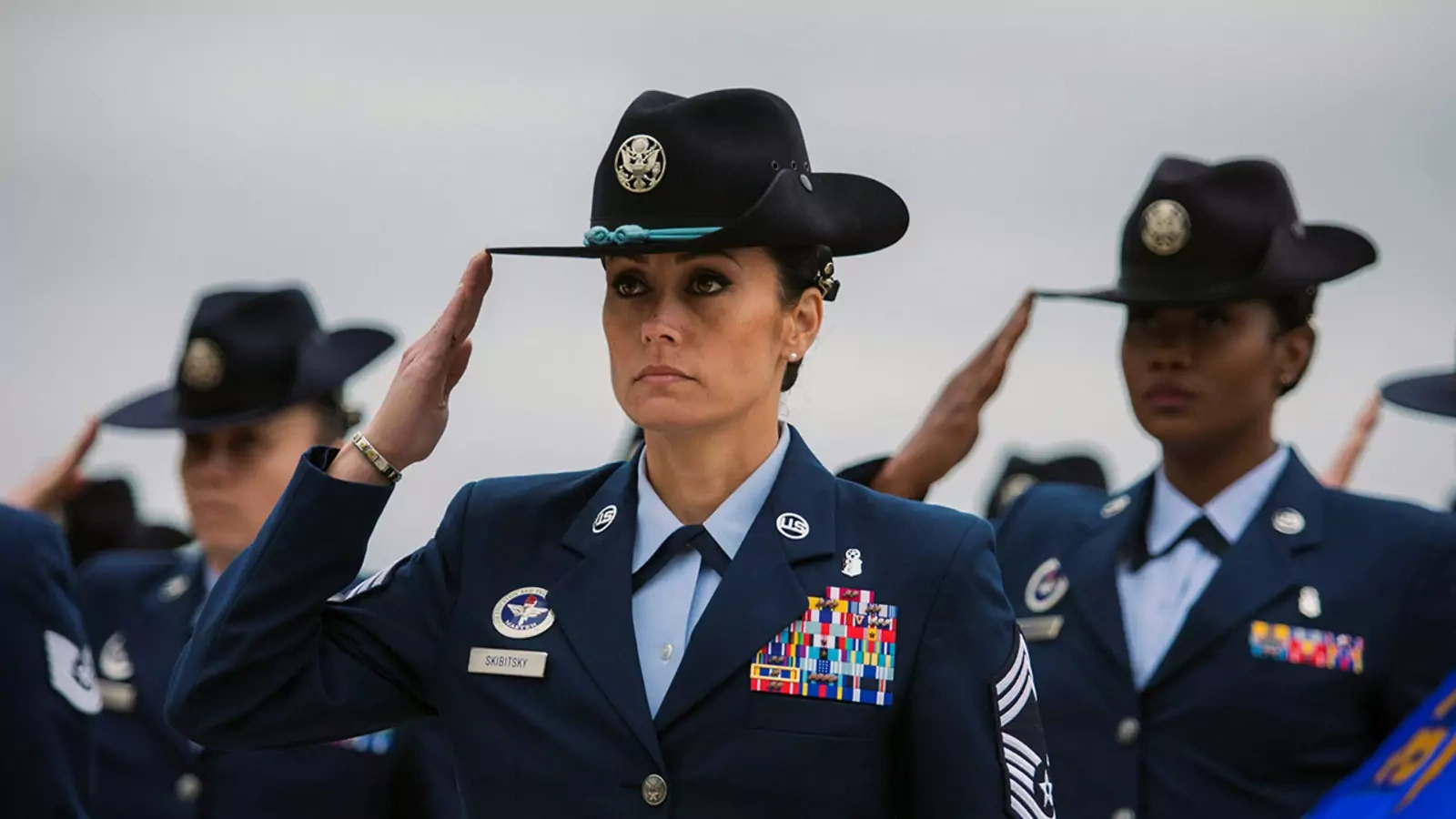
Today, women represent 16 percent of the enlisted forces and 19 percent of the officer corps. Ismael Ortega/U.S. Air Force via Reuters
Deployed around the world, the armed forces are a pillar of U.S. power and influence abroad. But many civilians are unfamiliar with their composition. How much does the military resemble U.S. society?
Backgrounder by CFR.org Editors
Last updated July 13, 2020
Introduction
The U.S. military has taken significant steps over the past decade to build a more diverse and inclusive force that attracts the country’s top talent. In particular, the services have opened more doors for women in recent years, ending restrictions on combat roles. However, women and racial and ethnic minorities remain underrepresented in parts of the military, particularly at the highest levels of leadership. The military has also opened its ranks to openly gay individuals, but it has maintained broad prohibitions on those who are transgender.
What are the military services?
The organizational structure of the U.S. military is complex. The Department of Defense has three military departments—Army, Navy, and Air Force—but there are six armed services. The Army is organized within its own department, while the navy and Marine Corps both fall under the Department of the Navy, and the Air Force and the newly established Space Force are services within the Department of the Air Force.
The Coast Guard is by law “a military service and a branch of the armed forces” but is part of the Department of Homeland Security. That is because the coast guard is predominately a law enforcement agency, although it does deploy with the navy and marine corps on certain missions. Collectively, the three maritime forces are sometimes called the sea services.
Daily News Brief
A summary of global news developments with CFR analysis delivered to your inbox each morning. Most weekdays.
Email Address
Additionally, there are seven reserve military forces [PDF], which will not be discussed here.
How big are the military services?
The United States ended the draft for military service in 1973, transitioning to the all-volunteer force that exists today. At that time, the active component of the military, excluding the coast guard, comprised 1.9 million men and women, or about 1 percent of the population. Now, there are about 1.3 million active-duty personnel, or less than one-half of 1 percent of the U.S. population.
More From Our Experts
Paul B. Stares
Conflicts to Watch in 2021
Max Boot
Iran-Backed Militias in Iraq Poised to Expand Influence
Sheila A. Smith
Beginning the Post-Abe Era
The army is the largest U.S. military service, followed by the navy, air force, marine corps, and coast guard. The space force became its own branch of the armed services in late 2019 and is still developing.
Active-Duty Personnel by Service, 2018
Coast Guard
(3%)
Marine Corps
(14%)
Army
(35%)
Total:
1.3M
Air Force
(24%)
Navy
(24%)
Source : Office of the Undersecretary of Defense.
How old are service members?
The military, which has strict age limits, is younger than the civilian population, but the numbers differ significantly by service. The age ranges of the services vary most on the enlisted side: the coast guard tends to have older members, and marines tend to be younger. About 70 percent of enlisted marines are twenty-four years old or younger, compared with about 30 percent of enlisted coast guard members.
More on:
Age Distribution by Service, 2018
Age of active-duty commissioned officers and enlisted force
17–24
25–34
35–44
45+
Officers
0%
100%
Army
Navy
Marine Corps
Air Force
Coast Guard
Enlisted
0%
100%
Army
Navy
Marine Corps
Air Force
Coast Guard
Recruit age cutoffs
Marine Corps: 28
Navy: 34
Army: 35
Air Force: 39
Coast Guard: 39
Source : Office of the Undersecretary of Defense.
How affluent are enlisted recruits?
Most members of the military come from middle-class neighborhoods. The middle three quintiles for household income were overrepresented among enlisted recruits, and the top and bottom quintiles were underrepresented.
Middle Class Overrepresented Among Recruits
Share of recruits by neighborhood income level
Civilian
Share of recruits
benchmark
|
|
17%
$87,851 and over
21%
$66,598–$87,850
22%
$53,549–$66,597
21%
$41,692–$53,548
19%
Up to $41,691
15%
10%
20%
Notes: Income ranges represent the median household income quintiles for all U.S. census tracts. Each quintile includes 20 percent of the U.S. population. Coast Guard data not available.
Source : Office of the Undersecretary of Defense.
Where are enlisted recruits from?
Enlisted military members come from all fifty states and the District of Columbia, but some contribute more than others. In absolute terms, the top five for recruitment in 2018 were California, Texas, Florida, Georgia, North Carolina, and New York, which is reflective of their relatively large populations.
Number of Enlisted Recruits, 2018
Number of recruits
0–2K
2K–4K
4K–6K
6K
or more
AK
ME
VT
NH
WA
ID
MT
ND
MN
IL
WI
MI
NY
RI
MA
OR
NV
WY
SD
IA
IN
OH
PA
NJ
CT
KY
CA
UT
CO
NE
MO
WV
VA
MD
DE
NM
TN
DC
KS
AZ
AR
NC
SC
AL
GA
OK
LA
MS
TX
FL
HI
California had the largest number of people enlist in the services, with 19,504 recruits.
Notes: Coast Guard data not available.
Source : Office of the Undersecretary of Defense.
Another way of analyzing this data is to look at representation ratios, which show recruits as a share of a jurisdiction’s residents between the ages of eighteen and twenty-four. From this perspective, the picture is significantly different. A ratio of 1.0 means the jurisdiction’s share of recruits in 2018 was equal to its share of eighteen- to twenty-four-year-olds.
Representation of States Among Enlisted Recruits, 2018
Ratio of enlisted recruits to civilian 18–24 year olds
Underrepresented
Overrepresented
0.5
0.7
0.9
1.1
1.3
1.5
AK
ME
VT
NH
ND
MN
IL
WI
MI
NY
RI
WA
ID
MT
MA
PA
NJ
CT
OR
NV
WY
SD
IA
IN
OH
KY
CA
UT
CO
NE
MO
WV
VA
MD
DE
DC
NM
KS
TN
AZ
AR
NC
SC
AL
GA
OK
LA
MS
TX
FL
HI
Washington, DC, had the lowest ratio, at 0.3.
South Carolina had the largest, with 1.5.
Notes: Coast Guard data not available.
Source : Office of the Undersecretary of Defense.
South Carolina had the highest representation ratio, at 1.5, meaning it contributed 50 percent more than its share of the country’s eighteen- to twenty-four-year-old population. Florida, Hawaii, Georgia, and Alabama round out the top five. On the other end of the spectrum—jurisdictions that contribute fewer recruits than their share of eighteen- to twenty-four-year-olds, or those with ratios less than 1.0—are Washington, DC, North Dakota, Massachusetts, Utah, and Rhode Island.
How racially and ethnically diverse is the military?
Federal agencies categorize race into five groups—white, Black or African American, American Indian or Alaska Native, Asian, and Native Hawaiian or other Pacific Islander. Ethnicity, which the government considers distinct from race, is divided into two categories: Hispanic or Latino, and not Hispanic or Latino. The racial and ethnic diversity of enlisted recruits varies considerably across the services and between genders.
Race and Ethnicity of Enlisted Recruits by Service and Gender, 2018
Hispanic, considered an ethnicity and not a race, overlaps with racial categories.
100%
0%
100%
Male
Female
Civilian labor force, 18–44
White
Black
Asian
Hispanic
(ethnicity)
Lines indicate the civilian labor force percentage as a point of comparison.
In all the services, minority representation is higher among female recruits than among male recruits.
Army
Navy
Marine Corps
Air Force
Coast Guard
Notes: Only the three largest racial categories were included—white, Black, and Asian. Numbers do not add to one hundred because of excluded groups and because Hispanic ethnicity is considered separately from race.
Source : Office of the Undersecretary of Defense.
Racial diversity decreases at the upper echelons of the military. While the officer corps has similar levels of racial diversity as the general population, those with higher ranks—generals in the air force, army, and marine corps, and admirals in the coast guard and navy—are disproportionately white. There is an even greater ethnic disparity in the top ranks.
Race and Ethnicity by Rank, 2018
Race
White
Black
Asian
Other
General/flag officers
All officers
Enlisted
U.S. (age 18–64)
0%
100%
Ethnicity
Non-Hispanic
Hispanic
General/flag officers
All officers
Enlisted
U.S. (age 18–64)
0%
100%
Notes: Hispanic, considered an ethnicity and not a race, overlaps with racial categories.
Source : Congressional Research Service.
At what levels are women serving?
When the draft ended in 1973, women represented just 2 percent of the enlisted forces and 8 percent of the officer corps. Today, those numbers are 16 percent and 19 percent, respectively, a significant increase over the past half century.
Again, the numbers vary widely by service. Women accounted for about one-fifth of the officers in every military service except the marine corps, where they made up just 8 percent of the total. In the army, air force, and coast guard, the ratio of women officers was higher than that for women enlisted.
Women’s Representation by Service and Rank, 2018
Female representation among active-duty commissioned officers and enlisted force
Army
19%
Officers
14%
Enlisted
Navy
19%
Officers
20%
Enlisted
Marine Corps
8%
Officers
9%
Enlisted
Air Force
21%
Officers
20%
Enlisted
Coast Guard
23%
Officers
13%
Enlisted
Source : Office of the Undersecretary of Defense.
Do LGBTQ+ individuals serve in the military?
The military does not report data on LGBTQ+ service members.
President Barack Obama’s administration allowed openly gay individuals to serve in the military with its repeal of the “Don’t ask, don’t tell” policy in 2010. Prior to that, gay, lesbian, and bisexual individuals could serve but were forced to conceal their sexual orientation.
In 2016, President Obama allowed transgender individuals to also serve openly in the armed forces, but the policy shift was later reversed by President Donald J. Trump. Today, the military does not accept transgender recruits, with few exceptions, but it allows those who entered between the 2016 decision and Trump’s reversal to continue to serve.
Where are enlisted recruits from?
Creative Commons: Some rights reserved.
Explore More on Defense and Security
No, the United States Does Not Spend Too Much on Cyber Offense
by Robert K. KnakeDecember 22, 2020
The Western Hemisphere Drug Policy Commission: Charting a New Path Forward
by Shannon K. O’NeilDecember 3, 2020
by Lindsay Maizland and Eleanor AlbertNovember 24, 2020
Top Stories on CFR
China’s Starring Role in Hollywood
with Gabrielle Sierra, Aynne Kokas and James TagerJanuary 6, 2021
by Richard N. HaassJanuary 11, 2021
From the Arab Spring to the American Winter: Cyberspace and Democracy After the Insurrection
by David P. FidlerJanuary 11, 2021
©2021 Council on Foreign Relations. All rights reserved.Privacy Policy and Terms of Use.
 Solar
Solar 