

Cricket phone unlock code is 26851971. Thank you for being part of the Cricket nation.
https://careertrend.com/how-7394528-build-massage-chair.html

Home » Job Descriptions » Industrial Job Tips
HOW TO BUILD A MASSAGE CHAIR
By Phree Norde; Updated July 05, 2017

ballyscanlon/Stockbyte/Getty Images
Enjoy a stress-relieving massage in the comfort of your own home. According to Living Life Abundantly, stress is on the rise, mainly due to the economic crisis. Frequent massages can help reduce the level of stress. If you can’t afford a professional masseuse, a massage chair will suffice. However, you don’t have to go out and buy an expensive leather massage chair. Believe it or not, you can make your own with tennis balls and a little creativity.
Measure the length and width of the seat and back support of the dining chair frame to determine how big your pieces of plywood need to be. Use a saw to cut the big piece of plywood into four parts, two the size of the seat support frame and two the size of the back support frame.
Determine how many rows of tennis balls your seat can comfortably fit. The seat and the back will each have either four rows of four tennis balls, or five rows of five balls. For example, if your plywood can hold five rows of five balls, then you will need 25 balls for the seat and 25 for the back for a total of 50 balls.
Use a tennis ball to trace your rows and columns of circles on to one piece of the seat plywood and one piece of the back plywood. Use a jigsaw to cut out the traced circles.
Use the golf ball to trace a set of smaller circles on the remaining two pieces of plywood. These plywood pieces will serve as the back piece to the plywood pieces with tennis-ball sized holes. Use the jigsaw to cut the traced golf ball circles. The smaller holes are to ensure that the tennis ball will not push through the large holes, but will allow the balls to roll within the holes.
Line up the piece with large holes that fits the back support of the chair frame. Use the existing holes in the chair frame to determine where you will drill holes to attach the plywood to the frame. Use a marker to mark spots on the wood that correspond to the holes on the chair frame. Power drill holes into the marked spots big enough to fit bolts. Repeat the step with the plywood containing the smaller holes. Follow the same steps for the two pieces of plywood for the seat support of the chair frame, using the existing holes in the seat of the frame for the bolt holes.
Attach the plywood with the big holes to the front side of the back support of the chair using bolts. The bolts should be long enough to go through two pieces of plywood and the chair frame with room to spare for a nut. Once the bolts are through the large-hole plywood and chair frame, attach the plywood with the small holes to the back of the chair frame and secure the bolts with nuts. Repeat this procedure for the seat support portion of the chair, making sure the plywood piece with big holes is the top piece.
Place tennis balls in all the large holes. Roll your back and bottom around on the balls to enjoy your self-made massage chair.
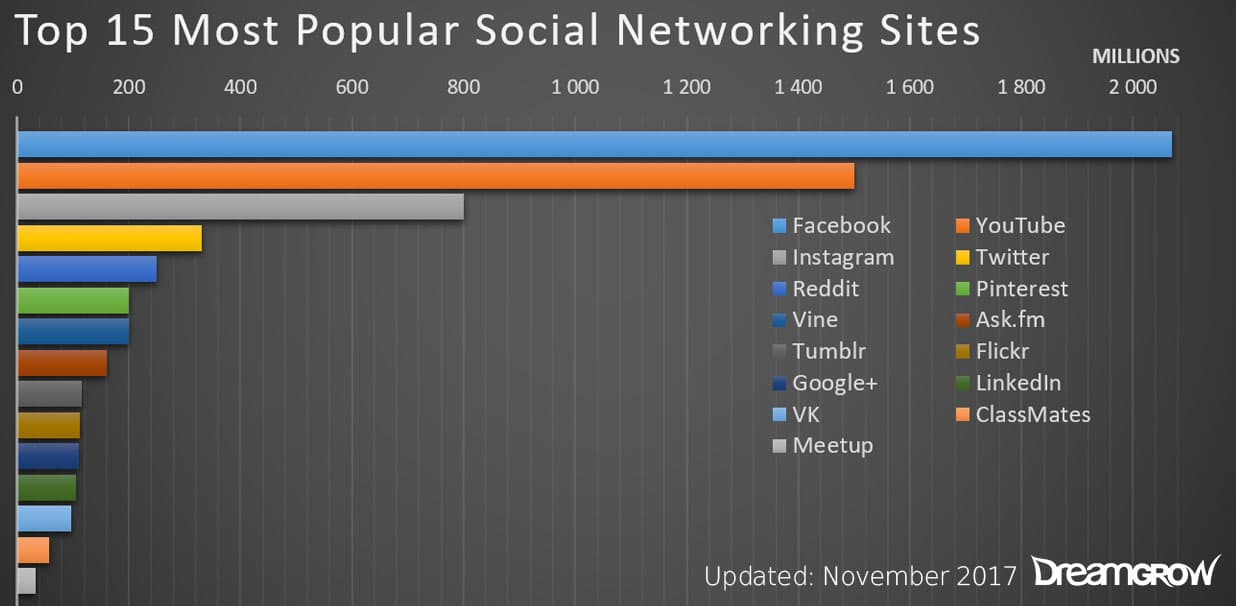
Social network
Monthly Active Users
size comparison
Again, on this graph you can see the three large circles dominating the rest. Only Twitter and Reddit battling it out for the fourth space seem to come close to the top 3. However, in Russia VK has a huge penetration, dominating the Russian speaking world as Facebook does globally.

 World Map of Social Networks 2017
Take a look at the visualization showing the most popular social networks around the world. The world map of social networks 2017 is based on recent traffic data (January 2017). Check out the world map of social networks…
And wait, we hav e news for you! There is some indication that a new social network might take the to spot. YouTube might be taking over Facebook in unique monthly visitors:
YouTube – 2 – Compete Rank | 2 – Alexa Rank
Facebook – 3 – Compete Rank | 3 – Alexa Rank
If you want to find out more about how powerful video is predicted to become, check out this infographic!
You can also take a look at our interactive graph
Top 10 Social Networking Sites by Market Share of Visits [USA]
Top Social Networking Apps
With the growing popularity of mobile social networking, we have also created a list of 10 leading social apps globally. These apps are in fierce competition with the main social sites already!
Read next: How Powerful Will Video Marketing Become? [infographic]
The picture here is a bit different if we look at the brand names. WhatsApp and Messenger are in a close race for the top spot. But both of theses most popular social media apps are owned by Facebook so the competition may not be as fierce as between completely separate companies. Then there’s a lot of Asian apps and then on the sixth spot is Instagram, again owned by Facebook.
WhatsApp added another 100 million monthly active users reaching 1.3 billion and leaving Facebook Messenger behind with 1.2 billion monthly active users. Both of these mobile platforms are owned by Facebook.WeChat took the 3rd position as it passed QQ with more than 70 million monthly active users as QQ continues to slide.
Social Networking App
Monthly Active Users
Messenger(owned by Facebook)1,300,000,000WhatsApp (owned by Facebook)1,300,000,000WeChat938,000,000QQ Chat861,000,000Instagram (owned by Facebook)800,000,000QZone652,000,000Viber249,000,000LINE218,000,000Snapchat200,000,000YY122,000,000
Social networking apps are going to grow even bigger as people adopt them into their everyday lives. Here we have listed the mobile-first social media platforms. But the Facebook mobile app would dominate this list with 1.2+ billion monthly active users. As smartphones’ adoption continues, the share of the desktop use of social media platforms will fall .
For list of social media apps that are smaller check List of virtual communities with more than 100 million active users from Wikipedia.
I’m listening to "The Moment Of Truth" by Survivor on Pandora.
https://www.pandora.com/survivor/karate-kid/moment-of-truth/TRnnzfwg36klc9c?shareImp=true&isGooglePlay=1&sp=1&isBrowse=true
https://gist.github.com/lancejpollard/1978404
meta-tags.md
Copied from http://code.lancepollard.com/complete-list-of-html-meta-tags/
Basic HTML Meta Tags
<meta name="keywords" content="your, tags"/>
<meta name="description" content="150 words"/>
<meta name="subject" content="your website’s subject">
<meta name="copyright"content="company name">
<meta name="language" content="ES">
<meta name="robots" content="index,follow" />
<meta name="revised" content="Sunday, July 18th, 2010, 5:15 pm" />
<meta name="abstract" content="">
<meta name="topic" content="">
<meta name="summary" content="">
<meta name="Classification" content="Business">
<meta name="author" content="name, email">
<meta name="designer" content="">
<meta name="copyright" content="">
<meta name="reply-to" content="email">
<meta name="owner" content="">
<meta name="url" content="http://www.websiteaddrress.com">
<meta name="identifier-URL" content="http://www.websiteaddress.com">
<meta name="directory" content="submission">
<meta name="category" content="">
<meta name="coverage" content="Worldwide">
<meta name="distribution" content="Global">
<meta name="rating" content="General">
<meta name="revisit-after" content="7 days">
<meta http-equiv="Expires" content="0">
<meta http-equiv="Pragma" content="no-cache">
<meta http-equiv="Cache-Control" content="no-cache">
OpenGraph Meta Tags
<meta name="og:title" content="The Rock"/>
<meta name="og:type" content="movie"/>
<meta name="og:url" content="http://www.imdb.com/title/tt0117500/"/>
<meta name="og:image" content="http://ia.media-imdb.com/rock.jpg"/>
<meta name="og:site_name" content="IMDb"/>
<meta name="og:description" content="A group of U.S. Marines, under command of…"/>
<meta name="fb:page_id" content="43929265776" />
<meta name="og:email" content="me"/>
<meta name="og:phone_number" content="650-123-4567"/>
<meta name="og:fax_number" content="+1-415-123-4567"/>
<meta name="og:latitude" content="37.416343"/>
<meta name="og:longitude" content="-122.153013"/>
<meta name="og:street-address" content="1601 S California Ave"/>
<meta name="og:locality" content="Palo Alto"/>
<meta name="og:region" content="CA"/>
<meta name="og:postal-code" content="94304"/>
<meta name="og:country-name" content="USA"/>
<meta property="og:type" content="game.achievement"/>
<meta property="og:points" content="POINTS_FOR_ACHIEVEMENT"/>
<meta property="og:video" content="http://example.com/awesome.swf" />
<meta property="og:video:height" content="640" />
<meta property="og:video:width" content="385" />
<meta property="og:video:type" content="application/x-shockwave-flash" />
<meta property="og:video" content="http://example.com/html5.mp4" />
<meta property="og:video:type" content="video/mp4" />
<meta property="og:video" content="http://example.com/fallback.vid" />
<meta property="og:video:type" content="text/html" />
<meta property="og:audio" content="http://example.com/amazing.mp3" />
<meta property="og:audio:title" content="Amazing Song" />
<meta property="og:audio:artist" content="Amazing Band" />
<meta property="og:audio:album" content="Amazing Album" />
<meta property="og:audio:type" content="application/mp3" />
Create Custom Meta Tags
Use custom meta tags to store data that you need in javascript, instead of hard-coding that data into your javascript. I store my Google Analytics code in meta tags. Here’s some examples:
<meta name="google-analytics" content="1-AHFKALJ"/>
<meta name="disqus" content="abcdefg"/>
<meta name="uservoice" content="asdfasdf"/>
<meta name="mixpanel" content="asdfasdf"/>
Company/Service Meta Tags
ClaimID
<meta name="microid" content="mailto+http:sha1:e6058ed7fca4a1921cq91d7f1f3b8736cd3cc1g7" />
Apple Meta Tags
<meta name="apple-mobile-web-app-capable" content="yes">
<meta content="yes" name="apple-touch-fullscreen" />
<meta name="apple-mobile-web-app-status-bar-style" content="black">
<meta name="format-detection" content="telephone=no">
<meta name="viewport" content="width = 320, initial-scale = 2.3, user-scalable = no">
Internet Explorer Meta Tags
<meta http-equiv="Page-Enter" content="RevealTrans(Duration=2.0,Transition=2)" />
<meta http-equiv="Page-Exit" content="RevealTrans(Duration=3.0,Transition=12)" />
<meta name="mssmarttagspreventparsing" content="true">
<meta http-equiv="X-UA-Compatible" content="chrome=1">
<meta name="msapplication-starturl" content="http://blog.reybango.com/about/"/>
<meta name="msapplication-window" content="width=800;height=600"/>
<meta name="msapplication-navbutton-color" content="red"/>
<meta name="application-name" content="Rey Bango Front-end Developer"/>
<meta name="msapplication-tooltip" content="Launch Rey Bango’s Blog"/>
<meta name="msapplication-task" content="name=About;action-uri=/about/;icon-uri=/images/about.ico" />
<meta name="msapplication-task" content="name=The Big List;action-uri=/the-big-list-of-javascript-css-and-html-development-tools-libraries-projects-and-books/;icon-uri=/images/list_links.ico" />
<meta name="msapplication-task" content="name=jQuery Posts;action-uri=/category/jquery/;icon-uri=/images/jquery.ico" />
<meta name="msapplication-task" content="name=Start Developing;action-uri=/category/javascript/;icon-uri=/images/script.ico" />
<link rel="shortcut icon" href="/images/favicon.ico" />
TweetMeme Meta Tags
<meta name="tweetmeme-title" content="Retweet Button Explained" />
Blog Catalog Meta Tags
<meta name="blogcatalog" />
Rails Meta Tags
<meta name="csrf-param" content="authenticity_token"/>
<meta name="csrf-token" content="/bZVwvomkAnwAI1Qd37lFeewvpOIiackk9121fFwWwc="/>
Apple Tags
<meta name="apple-mobile-web-app-capable" content="yes">
<meta name="apple-mobile-web-app-status-bar-style" content="black">
<meta name="format-detection" content="telephone=no">
<meta name= "viewport" content = "width = 320, initial-scale = 2.3, user-scalable = no">
<meta name= "viewport" content = "width = device-width">
<meta name = "viewport" content = "initial-scale = 1.0">
<meta name = "viewport" content = "initial-scale = 2.3, user-scalable = no">
<link rel="apple-touch-icon" href="touch-icon-iphone.png" />
<link rel="apple-touch-icon" sizes="72×72" href="touch-icon-ipad.png" />
<link rel="apple-touch-icon" sizes="114×114" href="touch-icon-iphone4.png" />
<link rel="apple-touch-startup-image" href="/startup.png">
<link rel="apple-touch-icon" type="image/png" href="/apple-touch-icon.png" />
HTML Link Tags
<link rel="alternate" type="application/rss+xml" title="RSS" href="http://feeds.feedburner.com/martini" />
<link rel="shortcut icon" type="image/ico" href="/favicon.ico" />
<link rel="fluid-icon" type="image/png" href="/fluid-icon.png" />
<link rel="me" type="text/html" href="http://google.com/profiles/thenextweb"/>
<link rel=’shortlink’ href=’http://blog.unto.net/?p=353‘ />
<link rel=’archives’ title=’May 2003′ href=’http://blog.unto.net/2003/05/‘ />
<link rel=’index’ title=’DeWitt Clinton’ href=’http://blog.unto.net/‘ />
<link rel=’start’ title=’Pattern Recognition 1′ href=’http://blog.unto.net/photos/pattern_recognition_1_about/‘ />
<link rel=’prev’ title=’OpenSearch and OpenID? A sure way to get my attention.’ href=’http://blog.unto.net/opensearch/opensearch-and-openid-a-sure-way-to-get-my-attention/‘ />
<link rel=’next’ title=’Not blog’ href=’http://blog.unto.net/meta/not-blog/‘ />
<link rel="search" href="/search.xml" type="application/opensearchdescription+xml" title="Viatropos" />
<link rel="self" type="application/atom+xml" href="http://www.syfyportal.com/atomFeed.php?page=3"/>
<link rel="first" href="http://www.syfyportal.com/atomFeed.php"/>
<link rel="next" href="http://www.syfyportal.com/atomFeed.php?page=4"/>
<link rel="previous" href="http://www.syfyportal.com/atomFeed.php?page=2"/>
<link rel="last" href="http://www.syfyportal.com/atomFeed.php?page=147"/>
<link rel=’shortlink’ href=’http://smallbiztrends.com/?p=43625‘ />
<link rel="canonical" href="http://smallbiztrends.com/2010/06/9-things-to-do-before-entering-social-media.html" />
<link rel="EditURI" type="application/rsd+xml" title="RSD" href="http://smallbiztrends.com/xmlrpc.php?rsd" />
<link rel="pingback" href="http://smallbiztrends.com/xmlrpc.php" />
<link media="only screen and (max-device-width: 480px)" href="http://wordpress.org/style/iphone.css" type="text/css" rel="stylesheet" />
Other Resources
Dublic Core Meta Tags
Apple Meta Tags
OpenGraph Meta Tags
Link Tag Meaning
Google Chrome HTML5 Tags
lcerbaro
commented over 4 years ago
Invalid Markup Validation is Invalid.
jonathanong
commented almost 4 years ago
add twitter stuff? https://dev.twitter.com/docs/cards/markup-reference
joshbuchea
commented over 1 year ago
I started a project (HEAD) with the aim to be a comprehensive list of everything that goes in the <head> of your document. This gist is one of the resources I used to compile my initial list. Thanks for the great resource @lancejpollard!
jflynn33
commented 10 months ago
Awesome, thanks! If you’re still maintaining this Gist, you could collapse the Apple Meta Tags and Apple Tags sections. Well done!
behiyegok
commented 3 months ago
thank you
KamranBhatti
commented 3 months ago
That’s so amazing.
KamranBhatti
commented 3 months ago
If these tags would be explained. That would be amazing.
goldylucks
commented 3 months ago
Is still relevant?
The consumers of meta tags (browsers, smartphones) might have many of these built in by now
gdsram commented about 1 month ago • edited about 1 month ago
Great Summary!!
Isn’t it property="og:image" instead of name="og:image" in the OpenGraph section?
Peace-N
commented about 1 month ago
Very useful thanks so much !!
DaniSpringer
commented about 1 month ago
@gdsram yes
@jflynn33 meaning?
AnjaneyuluBatta505
commented 22 days ago
@lancejpollard awesome!!! thanks.
Comment on gist
Leave a comment
Comment
Desktop version
<title>relevant and attractive phrase </title>
<meta name="description" content="text">
<meta name="keywords" content="words">
<meta name="robots" content="selection">
<meta name="revisit-after" content="period">
<meta name="copyright" content="text">
<meta name="googlebot" content="noodp">
<meta name="language" content="English">
<meta name="reply-to" content="email address">
<meta name="web_author" content="text">
<meta http-equiv="name" content="value">
<meta name="ROBOTS" CONTENT="NOARCHIVE">
<meta name="GOOGLEBOT" CONTENT="NOSNIPPET">
meta name="identifier-URL"CONTENT="http://www.your-domain-name.com/">
<meta name="distribution" CONTENT="Global">
<meta name="note" CONTENT="place extra keywords here">
<meta name="subject" CONTENT="your website’s subject">
<meta name="copyright"CONTENT="company name">
<meta name="language" CONTENT="ES">
<meta name="version" CONTENT="MT5.1"
<meta name="generator" CONTENT="program"
<meta name="id" CONTENT="sitebuilder-software"
<meta name="rating" CONTENT="general"
<meta name="presdate" CONTENT="date"
<meta name="template" CONTENT="basisdoc.html"
<meta name="operator" CONTENT="John Smith"
<meta name="creation_date" CONTENT="date"
<meta name="host" CONTENT="www.metatags.org"
<meta name="host-admin" CONTENT="Mike Demo"
<meta name="contactName"CONTENT="Mr. E. Xample">
<meta name="contactOrganization" CONTENT="Company XYZ inc.">
<meta name="contactStreetAddress1"CONTENT="Mainstreet 123">
<meta name="contactZipcode"CONTENT="98979">
<meta name="contactCity"CONTENT="New York">
<meta name="contactCountry"CONTENT="USA">
<meta name="contactPhoneNumber" CONTENT="+1 123 6382824">
<meta name="contactFaxNumber"CONTENT="+1 123 5566779">
<meta name="contactNetworkAddress"CONTENT="your">
<meta name="linkage" CONTENT="http://www.meta-information.com/">
In March2017, the price of an Ether cryptocurrency token rose to an all-time high of around $25. This was good news for investors in Ethereum—the blockchain-based distributed computing platform that uses Ether as its currency—who had watched the cryptocurrency’s price stagnate at under $10 since its launch in July 2015. But it also had another profound effect on shaping the network: For the first time ever, it was truly profitable to mine Ether.
ADVERTISEMENT
I had been entertaining the idea of building an Ethereum mining rig for months and the price surge in May made it seem like as good a time as any to begin the process. So I sold some of my Ether, bought some computer hardware, and set to work learning about building PCs and the art of Linux.
But before I dive into the unnecessarily painful process of setting up an Ethereum mining rig as a complete n00b, let’s brush up on some Ethereum basics.
Mining is the term used to describe the process of extracting cryptocurrency tokens from a blockchain network. In the case of Ethereum, this involves having computers continuously run a hashing algorithm, which takes an arbitrarily large amount of information and condenses it to a string of letters and numbers of a fixed length. The hashing algorithm used by Ethereum— called ethash—hashes metadata from the most recent block using something called a nonce: a binary number that produces a unique hash value. For each new block in the blockchain, the network sets a target hash value and all the miners on the network try to guess the nonce that will result in that value.
Due to the way cryptographic hashing works, trying to guess the nonce that will result in the target value is practically impossible. This means that the only way of finding the correct nonce is by cycling through every possible solution until a correct one is eventually found. This is "proof-of-work," which means the computer which discovered the correct nonce must’ve actually done the work (i.e., used computing power to run the hashing algorithm) to arrive at that value. The miner that finds the correct nonce is then awarded the block, receives 5 ether, and the process then begins anew in a cycle that recurs about every 12 seconds.
Six RX 470 GPUs installed in my Ethereum mining rig. Yes, those are zip ties. Image:Daniel Oberhaus/Motherboard
Okay so that’s the big picture, but what does this look like on the mining side of things? For starters, a rig is going to need some serious processing power. This is best accomplished with Graphics Processing Units (GPUs), which are generally used for 3D graphics for video games. Although it’s possible to mine with Central Processing Units, which are generally responsible for linking up all the right hardware and software in a computer, GPUs are optimized to run similar operations over and over again—which makes them perfect for hashing on the Ethereum blockchain.
This is where the problems begin. Now that the cost of electricity to mine Ethereum is far less than the worth of the Ether being mined, there has been a boom in the number of miners on the Ethereum blockchain. Until cryptocurrencies came around, GPUs were the sole purview of PC gamers, but now that they can also be used for mining, there is a complete shortage of GPUs on the market. Unless you’re trying to buy used hardware, tracking down a GPU will be difficult for the foreseeable future.
ADVERTISEMENT
Read More: Cryptocurrency Mining is Fueling a GPU Shortage
I was fortunate enough to have secured six RX 470 GPUs right as the price of Ether started skyrocketing. Still, at this point GPUs were incredibly difficult to track down and I had to settle in terms of performance. But this was better than nothing—within hours of ordering my GPUs, the site had sold out of the rest of its stock.
If you’ve somehow managed to get your paws on some graphics cards, the next task is finding a motherboard and power supply unit that can handle all of your GPUs running at once. For this task, I got an MSI Z170a motherboard and a 1200 watt Corsair power supply. Each GPU will use anywhere from 100-250 watts of power. Mine average around 120 watts apiece, which puts the total rig around 800 watts. Power supply units function optimally at around three-quarters of their total load capacity, so a 1200 watt PSU suited my needs.
You’re also going to need some powered risers since six GPUs are not going to fit directly into the PCI slots on any motherboard. These also allow you to suspend the GPUs above the motherboard in your case which helps to dissipate heat and allow air to flow through the rig.
I used a dual core Intel processor with 2.8GHz and a 4GB TForce stick for my CPU and RAM, respectively. It’s nothing fancy, but mining Ethereum doesn’t require your computer to do much multitasking so cheaper CPUs and RAM will do the trick.
The motherboard setup. On the left is the 1200 W power supply unit. Each of those blue USB cables is connected to a powered riser which links the GPUs above to the motherboard. Image: Daniel Oberhaus/Motherboard
The final element on the hardware side of things was the rig’s case. Your typical PC case isn’t going to fit six graphics cards, so a custom case is necessary. A lot of companies sell pre-made mining rig cases online, but these can cost upwards of $150 and seemed easy enough to build myself. I made mine with some aluminum angles I had cut at a local hardware store, a few wooden boards for mounting the motherboard, a few dozen self-driving screws, and a power drill.
All told, the process of making a case took about an hour and cost a little under $50. When added to the total price of the hardware for the rig, my bill came to a little over $2000.
Now that the computer is all set up and looking nice*, it’s time for the software.
(* It is said that beauty is in the eye of the beholder. Motherboard staff writer Jason Koebler saw my machine and described it as "Not Safe for Life." Motherboard news editor Emanuel Maiberg described it as "filthy." Clearly, neither of them have any taste.)
Here your options are relatively limited: you can run your rig on Windows, Linux, or ethOS. Windows has the benefit of better driver support for your graphics cards and EthOS is a plug and play solution for anyone who doesn’t know Linux and isn’t trying to learn.
But half the reason I wanted to set up an Ethereum mining rig in the first place was to give myself an excuse to learn Linux, so I decided to set up my software the hard way. First I had to download and install Xubuntu, a lightweight version of the popular Ubuntu Linux distribution, onto my motherboard. This involved writing a Linux disc image file to a 32 GB USB stick, and plugging that USB stick into the motherboard. Easy enough.
Next, I had to download the graphics drivers for my AMD GPUs so that they could communicate with the motherboard and do parallel processing. These drivers are free on AMD’s website and their installation is easy enough using a few commands in the Ubuntu terminal. Finally, it was time to download Geth, which is program used to implement commands on my Ethereum node. After downloading the blockchain and pointing my rig to a wallet I had already set up on Mist, it was time to start mining.
Out of the box, my 6 GPUs had a total hashing power of around 120 MH/s—that’s 120 million hashing operations per second. By tweaking the settings for my GPUs, I hope to increase this to between 125 and 130 MH/s, but that’s about as good as I’ll get with these cards. This may sound like a lot, but the total Ethereum network has a hashrate of around 39.1 TH/s at the time of writing. That’s 39 trillion hashing operations per second, which makes my rig just a drop in this ocean of computing power.
Since Ether is rewarded based on discovering the correct nonce, the odds of this happening increase the more hashing operations you are able to work through each block. If I were to try to do this on my own using my rig, it could be months before I ‘won’ a single block.
Most other miners are in the same boat as I am and don’t have access to huge mining farms like Genesis. So to increase their odds, small miners band together in mining pools, which combine each individual miner’s computing power to hash blocks. With combined computing power, mining pools are able to solve a block every few minutes, and the reward of this block is distributed to the miners in that pool in proportion to the work they did to help solve it. This means you might make only a few thousandths of an Ether each day, but over time this adds up—especially if the price of Ether keeps increasing.
Each pool has different requirements and fees for joining. Although I am only contributing 120 MH/s to the pool I joined, this will result in about 35 Ether per year for my rig. Based on the mining difficulty and price of Ether at the time of writing, this should be nearly $8,000 per year after electricity costs.
So there you have it—a total Linux n00b with no previous PC building experience was able to get an Ethereum mining rig up and running with minimal difficulty (aside from some faulty hardware). So maybe building a PC isn’t so hard after all.
 Solar
Solar 
