Created with Photo Lab app #photolab
Created with Photo Lab app #photolab
Created with Photo Lab app #photolab

Last words of U.S. presidents.
George Washington (1732-1799)
Tis well.
After serving two terms as the nation’s first president, the hero of the American Revolution retired to his Virginia plantation in 1797. In mid-December 1799, after enduring harsh winter conditions on horseback while inspecting his property, Washington developed a severe sore throat and breathing difficulties. In an effort to cure him, Washington’s doctors might have drained too much of his blood, which mortally weakened the Founding Father.
John Adams (1735-1826)
Thomas Jefferson…
Adams’ last words are often cited as "Thomas Jefferson still survives." While both men died July 4, 1826 — the 50th anniversary of the signing of the Declaration of Independence — Jefferson actually died several hours earlier that day. While Adams would not have known this, there is no conclusive evidence that he actually included the words "still survives" before he expired.
Thomas Jefferson (1743-1826)
No, doctor, nothing more.
Jefferson’s last words are often cited as "Is it the Fourth?" — the 50th anniversary of the signing of the Declaration of Independence. While he did earlier ask this on his deathbed, these were not his last words.
John Quincy Adams (1767-1848)
This is the last of Earth! I am content!
James Polk (1795-1849)
I love you, Sarah. For all eternity, I love you.
Polk said this to his wife, who was at his side when he died in bed.
Zachary Taylor (1784-1850)
I regret nothing, but I am sorry that I am about to leave my friends.
Abraham Lincoln (1809-1865)
She won’t think anything about it.
Lincoln spoke these words in answer to wife Mary’s question concerning what another woman, seated next to them in Ford’s Theatre, would think if she spotted the Lincolns holding hands.
Andrew Johnson (1808-1875)
I need no doctor. I can overcome my own troubles.
Ulysses S. Grant (1822-1885)
Water.
Theodore "Teddy" Roosevelt(1858-1919)
Please put out the light.
Warren G. Harding (1865-1923)
That’s good. Go on, read some more.
Harding said this to his wife, Florence, as she read complimentary newspaper pieces about the president in their San Francisco hotel suite during a presidential trip to Alaska and the West Coast.
Franklin Delano Roosevelt(1882-1945)
I have a terrific pain in the back of my head.
"FDR" died of a cerebral hemorrhage (stroke) not long after.
Dwight Eisenhower (1890-1969)
I want to go. I’m ready to go. God, take me.
John F. Kennedy (1917-1963)
No, you certainly can’t.
Jacqueline Kennedy testified on June 5, 1964, that these were Kennedy’s last words — or "something" to this effect — in response to the statement by Nellie Connally, the wife of Texas Governor John Connally, who remarked just before an assassin’s bullet struck the president: "You certainly can’t say that the people of Dallas haven’t given you a nice welcome."
Richard Nixon (1913-1994)
Help
Radar gun build
STEP 1: MATERIALS
Arduino Microcontroller
The A B USB cable
seven segment led displays
I am using LTS-4802BJR-H1 seven segment displaysHC-SR04
Ultra sonic sensor
Solder+Soldering iron
Printed board to solder toWiresResistors
2 resistors between 330 ohm and 1000 ohm.
STEP 2: THE CIRCUIT DESIGN
I recommend to make the circuit first on a bread board so as to test and make sure your equipment works.
1. Plug the HC-SR04 sensor into a bread board and make sure that the pins are not in the same column.
2. Put in your seven segment displays and pay attention to the orientation that is required so that each pin has its own column.
3. Add one of the resistor sides into the common anode with the other side in an unused column.
4. Wire the unused column of the resistor to the 5V line.
5. Repeat steps 2, 3, and 4 for the second seven segment display.
Here is a data sheet on the seven segment displays http://media.digikey.com/pdf/Data%20Sheets/Lite-On...
The seven segment display is a common anode display. Therefore, most of the logic for turning an LED on will be backwards; meaning that setting the pin to high voltage will turn it off and setting it to low will turn the LED on. Also this means that you must have the 5V from the arduino go into the common anode.
Caution: Do not forget to include a current limiting resistor or you will burn out your seven segment display.
STEP3
Solder to printed board
STEP4: HOOK UP TO ARDUINO
1. Plug in the pins to their respective spot .
HC-SR04 Sensor plug insDigital pin 2 which is the input of the TrigDigital pin 4 is the echo input5V to the VCCGND to GNDSeven Segment Display1st seven segment display (ones place) pins 30 through 36Skip pin 7 on the seven segment display as it is the decimal point and not used2nd seven segment display (tens place) pins 37 through 43Skip pin 7 on the seven segment display as it is the decimal point and not used.
Use
Our oceans are dying . 1 million tons of plastic monthly for 12 million tons yearly are dumped into our oceans creating the DMS I call it a smell “like oysters” or “kinda seaweed-y.” It’s the scent of dimethyl sulfide, or DMS—a gas that’s been described as a Keystone molecule because it influences everything from the presence of birds to the formation of clouds.
DMS is produced when microscopic animals graze upon the algae that grows near the ocean surface. Since it doesn’t dissolve easily in water, it eventually makes its way into the overlying air. That’s why passing sailors can smell it. Some of the gas rises into the atmosphere, where it seeds the creation of clouds. And other DMS molecules drift through the skies until they find their way into the noses of birds.
Tube-nosed birds—the albatrosses, petrels, and shearwaters—soar across the open oceans, relying on their keen sense of smell to find food. For them, DMS is intensely alluring. This attraction makes sense. DMS gives away the presence of clouds of plankton, and so acts as a loud dinner bell, telling the birds where meals can be found. I volunteer to lead or participate in cleaning the plastic from our oceans as dead oceans mean a dead planet.
Clint on215 Trump264 win270
https://en.m.wikipedia.org/wiki/List_of_United_States_presidential_elections_by_popular_vote_margin
EditWatch this page
List of United States presidential elections by popular vote margin
In United States presidential elections, the national popular vote is the sum of all votes cast in every state and the District of Columbia.
The Twelfth Amendment to the United States Constitution provides the procedure by which the President and Vice Presidentare elected, which is through the Electoral College, so the national popular vote does not determine the outcome of the United States presidential election.
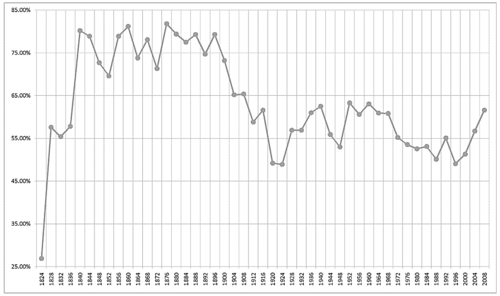
Graph of voter turnout percentage from 1824 to 2008.
ListEdit
The table below is sorted to display elections by their presidential term / year of election, name, margin by percentage in popular vote, popular vote, margin in popular vote by number, and the runner up in the Electoral College.
#YearElectoral CollegePartyPopular vote (%)Popular voteElectoral CollegePartyTurnoutWinnerMarginMarginRunner-up
Democratic-Republican Democratic Republican Whig Progressive Liberal Republican National Republican
Indicates winner lost popular vote
101824John Quincy AdamsD.-R.30.92%−10.44%113,142−38,221Andrew JacksonD.-R.26.90%231876Rutherford HayesRep.47.92%−3.00%4,034,142−252,666Samuel TildenDem.81.80%261888Benjamin HarrisonRep.47.80%−0.83%5,443,633−94,530Grover ClevelandDem.79.30%542000George W. BushRep.47.87%−0.51%50,460,110−543,816Al GoreDem.51.30%241880James GarfieldRep.48.31%0.09%4,453,3371,898Winfield Scott HancockDem.79.40%441960John KennedyDem.49.72%0.17%34,220,984112,827Richard NixonRep.62.77%251884Grover ClevelandDem.48.85%0.57%4,914,48257,579James BlaineRep.77.50%461968Richard NixonRep.43.42%0.70%31,783,783511,944Hubert HumphreyDem.60.84%151844James PolkDem.49.54%1.45%1,339,57039,413Henry ClayWhig78.90%481976Jimmy CarterDem.50.08%2.06%40,831,8811,683,247Gerald FordRep.53.55%552004George W. BushRep.50.73%2.46%62,040,6103,012,171John KerryDem.55.27%271892Grover ClevelandDem.46.02%3.01%5,553,898363,099Benjamin HarrisonRep.74.70%331916Woodrow WilsonDem.49.24%3.12%9,126,868578,140Charles Evans HughesRep.61.60%572012Barack ObamaDem.51.06%3.86%65,915,7964,982,296Mitt RomneyRep.54.87%281896William McKinleyRep.51.02%4.31%7,112,138601,331William Jennings BryanDem.79.30%411948Harry TrumanDem.49.55%4.48%24,179,3472,188,055Thomas DeweyRep.53.00%161848Zachary TaylorWhig47.28%4.79%1,360,235137,882Lewis CassDem.72.70%211868Ulysses GrantRep.52.66%5.32%3,013,790304,810Horatio SeymourDem.78.10%521992Bill ClintonDem.43.01%5.56%44,909,8065,805,256George H. W. BushRep.55.23%141840William Henry HarrisonWhig52.87%6.05%1,275,583145,938Martin Van BurenDem.80.20%291900William McKinleyRep.51.64%6.12%7,228,864857,932William Jennings BryanDem.73.20%171852Franklin PierceDem.50.83%6.95%1,605,943219,525Winfield ScottWhig69.60%562008Barack ObamaDem.52.93%7.27%69,498,5169,550,193John McCainRep.58.23%401944Franklin RooseveltDem.53.39%7.50%25,612,9163,594,987Thomas DeweyRep.55.90%511988George H. W. BushRep.53.37%7.72%48,886,5977,077,121Michael DukakisDem.50.15%531996Bill ClintonDem.49.23%8.51%47,400,1258,201,370Bob DoleRep.49.08%311908William TaftRep.51.57%8.53%7,678,3351,269,356William Jennings BryanDem.65.40%491980Ronald ReaganRep.50.75%9.74%43,903,2308,423,115Jimmy CarterDem.52.56%391940Franklin RooseveltDem.54.74%9.96%27,313,9454,966,201Wendell WillkieRep.62.50%201864Abraham LincolnRep.55.03%10.08%2,211,317405,090George McClellanDem.73.80%191860Abraham LincolnRep.39.65%10.13%1,855,993474,049John BreckinridgeDem.81.20%421952Dwight EisenhowerRep.55.18%10.85%34,075,5296,700,439Adlai StevensonDem.63.30%221872Ulysses GrantRep.55.58%11.80%3,597,439763,729Horace GreeleyL. R.71.30%181856James BuchananDem.45.29%12.20%1,835,140494,472John FrémontRep.78.90%111828Andrew JacksonDem.55.93%12.25%642,806140,839John Quincy AdamsN. R.57.60%131836Martin Van BurenDem.50.79%14.20%763,291213,384William Henry HarrisonWhig57.80%321912Woodrow WilsonDem.41.84%14.44%6,296,2842,173,563Theodore RooseveltProg.58.80%431956Dwight EisenhowerRep.57.37%15.40%35,579,1809,551,152Adlai StevensonDem.60.60%361928Herbert HooverRep.58.21%17.41%21,427,1236,411,659Al SmithDem.56.90%371932Franklin RooseveltDem.57.41%17.76%22,821,2777,060,023Herbert HooverRep.56.90%121832Andrew JacksonDem.54.74%17.81%702,735228,628Henry ClayN.R.55.40%501984Ronald ReaganRep.58.77%18.21%54,455,47216,878,120Walter MondaleDem.53.11%301904Theodore RooseveltRep.56.42%18.83%7,630,5572,546,677Alton Brooks ParkerDem.65.20%451964Lyndon JohnsonDem.61.05%22.58%43,127,04115,951,287Barry GoldwaterRep.61.92%471972Richard NixonRep.60.67%23.15%47,168,71017,995,488George McGovernDem.55.21%381936Franklin RooseveltDem.60.80%24.26%27,752,64811,070,786Alf LandonRep.61.00%351924Calvin CoolidgeRep.54.04%25.22%15,723,7897,337,547John DavisDem.48.90%341920Warren HardingRep.60.32%26.17%16,144,0937,004,432James CoxDem.49.20%
Note: The popular vote was not recorded prior to the 1824 election, so the first nine US presidential elections are not included in this table.
Timeline
See also
References
External links
Last edited 6 hours ago by an anonymous user
 ®
®
Content is available under CC BY-SA 3.0 unless otherwise noted.
Donald Trump 48% 52,607,546
Hillary Clinton 47% 51,439,842
Gary Johnson 3% 3,461,705
Stein 0.9% 971,621
Popular vote75% reporting
 Solar
Solar 